Uninterrupted Sleep Matters: Why "Protected Sleep Blocks" Are the Secret to Beating Postpartum Anxiety
Hey mama.
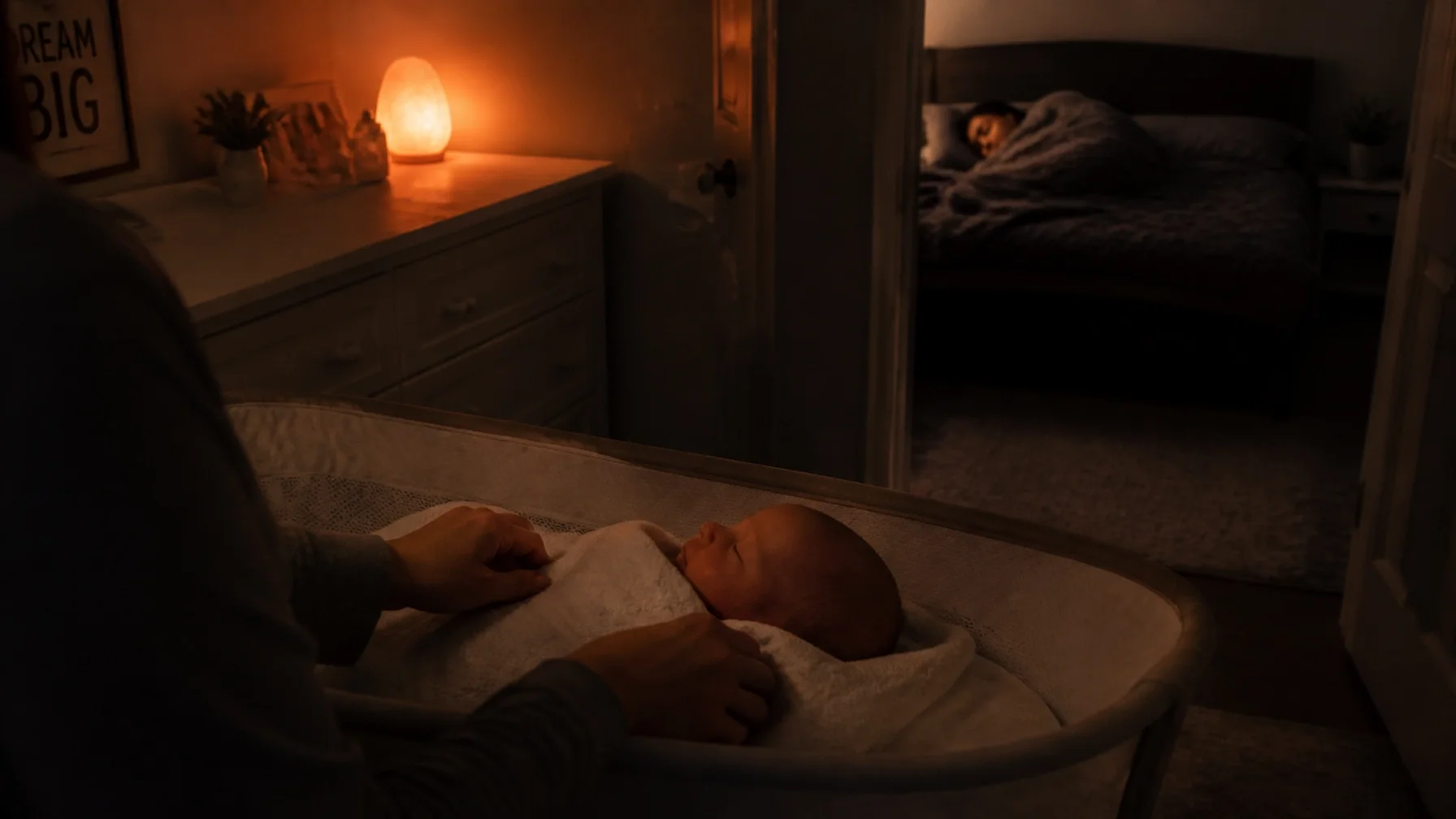
It’s 3:17 AM. You’re sitting in the glider, the rhythmic whoosh-whoosh of the white noise machine filling the room, and you’re staring at the wall. Your baby finally drifted off after forty-five minutes of "the wiggle," but instead of collapsing into bed, your heart is racing. You’re wondering if they’re breathing. You’re wondering if you remembered to lock the front door. You’re wondering if you’re ever going to feel like you again.
Sound familiar?
We’ve all been there. The "4 AM Wall" is real, and it’s lonely. But here’s the thing we don’t talk about enough: that buzzing, electric feeling in your chest? It might not just be "new mom jitters." It might be your brain screaming for a break.
At Rested, we see it every day in Atlanta homes. We see moms who are drowning in love for their babies but gasping for air because they haven’t had more than two hours of consecutive sleep in weeks.
Today, let’s talk about the biological necessity of Protected Sleep Blocks, and why they are the single most effective tool in your toolkit for fighting Postpartum Anxiety (PPA).
The Myth of the "Martyr Mom"
There’s this unspoken rule in our culture (eye roll) that if you aren't suffering, you aren't doing it right. We wear our exhaustion like a badge of honor. We brag about the spit-up on our shoulders and the three-day-old dry shampoo as if "suffering" is a prerequisite for "bonding."
The Myth: A "good mom" is always the one to wake up with the baby. To protect her partner’s sleep. To be the sole provider of comfort, 24/7.
The Reality: Sleep deprivation is a form of torture. Literally. It’s used in interrogations. When you deprive a human being of consolidated sleep, the brain begins to misfire. Your amygdala (the part of your brain that processes fear) goes into overdrive. Your prefrontal cortex (the part that does the logic) goes offline.
When you don't sleep, your brain cannot tell the difference between a real threat (the stove being left on) and a perceived threat (the "what if" thoughts that keep you up).

What Exactly is a "Protected Sleep Block"?
It’s not just a nap. It’s not "sleeping when the baby sleeps" (which we all know is the most annoying advice ever given to a parent).
A Protected Sleep Block is a planned, uninterrupted stretch of 4 to 6 hours where you are not the primary responder.
It means:
Physical Distance: You are in a different room, preferably with a fan or white noise so you don’t hear every tiny grunt.
Zero Responsibility: Someone else, a partner, a family member, or a Rested night nurse, is 100% responsible for the baby.
No "Listener’s Ear": You aren't hovering over the monitor. You are offline.
Why 4 to 6 hours? Because that is the minimum amount of time your brain needs to complete a full sleep cycle, including that sweet, sweet REM sleep that regulates your emotions. Without it, you aren't just tired; you're chemically imbalanced.
The Science (The Non-Boring Version)
When you sleep in "protected blocks," your body has a chance to clear out cortisol, the stress hormone. Postpartum, your hormones are already doing a chaotic dance. If you add high cortisol from sleep deprivation to the mix, it’s like pouring gasoline on a fire.
Studies show that poor sleep quality is one of the biggest predictors of Postpartum Anxiety and Depression. It’s a "modifiable risk factor." That’s fancy science talk for: If we fix the sleep, the mental health often follows.
When our Infant Care Specialists arrive at a home in Buckhead or Decatur, their first job isn't just to watch the baby. It’s to "clear the deck" for Mom. We take the baby, we handle the feeds (with pumped milk or formula), we do the diaper changes, and we track it all in our app.
You? You go to sleep. You wake up five hours later feeling like a human being again. The "whoosh" of anxiety starts to quiet down because your brain finally got the memo that it's safe to rest.
The "Rested" Reset: How It Works
We get it. Letting go is hard. Especially when your heart is literally walking around outside your body in a 7lb package. That’s why we don't just "show up."
We focus on the support of the whole family’s recovery.
When you use a service like Rested, your protected sleep block looks like this:
The Hand-off: Our specialist arrives, gets the "state of the union" on the baby’s day, and takes over.
The Sanctuary: You go to your room. We handle the laundry, the bottle washing, and the tracking in our app.
The Morning Reveal: You wake up to a happy baby, a clean kitchen, and a detailed night report.
You haven't been woken up by every "active sleep" grunt or "is he hungry?" whimpering. You’ve had five hours of deep, restorative sleep.
Suddenly, that mountain of laundry doesn't look so scary. The baby’s crying doesn't feel like a personal attack. You can actually think.
Tips for Creating Your Own Protected Sleep Blocks
If you aren't ready for a night nurse yet, or you’re in between shifts, here is how you can DIY a sleep block:
The 8 PM Hand-off: Have your partner or a family member take the baby from 8 PM to 1 AM. Go to bed at 8:30 PM. Yes, it feels early. Do it anyway.
Pump for One Feed: If you are breastfeeding, one bottle of pumped milk at night will not "ruin" your supply or the baby’s latch. (Real talk: Your mental health is more important than a perfect nursing streak.)
Use the "Roommate Rule": If your partner is taking a shift, they are the "Lead Parent." Unless the house is on fire, they do not come into your room to ask where the wipes are.
White Noise is Your Best Friend: Put a machine outside your door. You need to dampen the sound of the baby’s cries so your "mom ears" don't keep you in a state of hyper-vigilance.
Cutting Through the Noise
There is so much advice out there. You’re drowning in it. "Do this for sleep training," "Eat this for milk supply," "Wear this for development."
Ignore it for a second.
Focus on the foundation. You cannot build a healthy family on a foundation of total exhaustion. Prioritizing your sleep isn't selfish, it’s medical necessity.
If you’re in Atlanta and you feel like you’re reaching your breaking point, please know you don't have to do this alone. Whether it's through our meet & greets or our overnight care, we are here to hold the line so you can rest.
You’re doing a great job, mama. Really.
Morning, night, nap, repeat. It’s a rite of passage, but it doesn't have to be a nightmare. Trust your intuition. Trust your body’s need for rest. And remember: a well-rested mom is a powerhouse.
Sleep is coming. We promise.